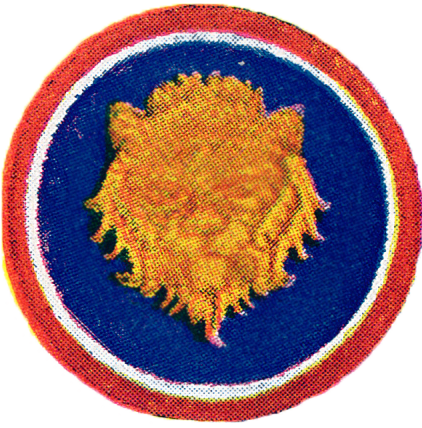
The 106th Infantry Division arrived in France in early December 1944 and moved into the Schnee Eifel sector on December 11, replacing the 2nd Infantry Division in an exposed salient of the front. Five days later, the German Ardennes counteroffensive struck with full force. The 422nd and 423rd Infantry Regiments, positioned deep in the salient, were quickly encircled near Schönberg; after days of fighting without resupply or relief, both regiments surrendered on December 19 — the largest mass surrender of American troops in the European theater. The 424th Infantry Regiment, on the division's southern flank, was pushed back across the Our River but maintained cohesion and joined other divisional elements in the defense of St. Vith on December 20. Reinforced by the 112th Infantry from the 28th Division, the St. Vith garrison held the critical road junction through repeated assault before withdrawing on December 23 under orders from higher command, having delayed German forces beyond their timetable.
Through the winter the division was rebuilt with replacement personnel and attached regiments. In March 1945, the 3rd Infantry and 159th Infantry were temporarily attached as the formation was reconstituted. When it returned to Germany in late April, the division was assigned to prisoner processing and military occupation duties in secure areas behind the front. The 422nd and 423rd Infantry were newly reformed from replacements in France and were still training when hostilities ended on May 7.
Its wartime record was defined entirely by the Ardennes catastrophe and the effort of its surviving elements to contribute to the battle's outcome despite the scale of the opening reverse.
(A) = attached
Sources and notes can be found on the Sources page.
View sources →