The 2nd Infantry Division landed across Omaha Beach on the evening of June 7, 1944 and moved quickly into the fighting inland, advancing through the Forêt de Cerisy and across the Elle and Aure Rivers. The division struck the formidable German strongpoint atop Hill 192, which commanded the approaches to Saint-Lô, beginning its assault on June 12. Fierce fighting for the hill continued through June and into July; when it fell on July 11, the Indianhead Division gained control of the Saint-Lô highway and helped clear the way for the Allied breakout. Crossing into Brittany on August 17, the 38th Infantry Regiment attacked the outer defenses of Brest on August 25 and by September 2 had seized Hill 105 dominating the eastern approaches. The all-out assault on the city commenced September 8, the division breaching the old city wall by September 17 before Brest surrendered — the 38th Infantry Regiment having fought at the heart of a thirty-nine-day siege.
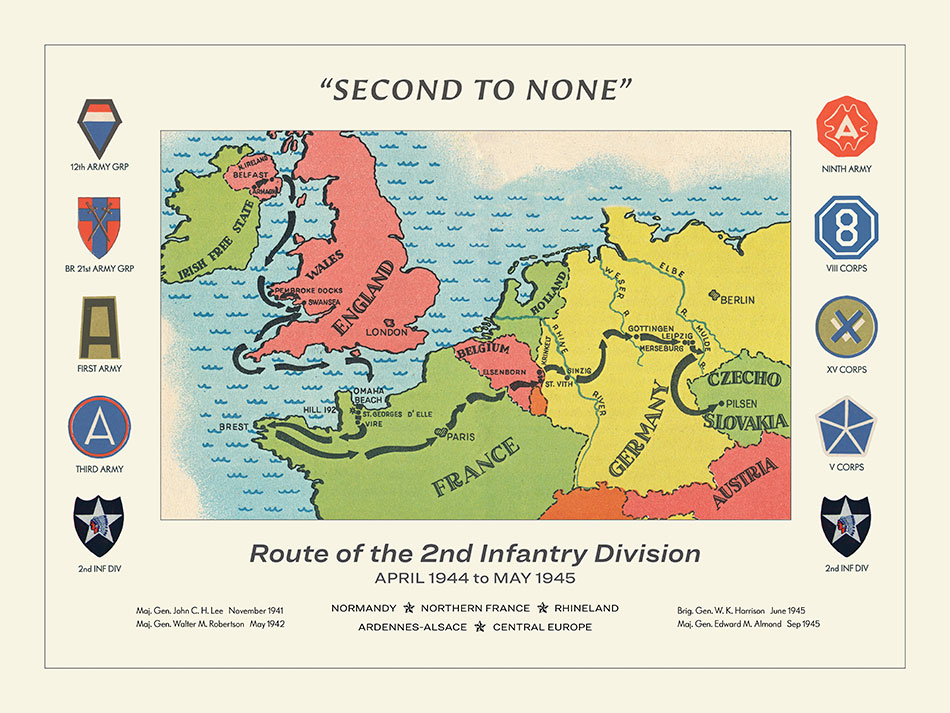
The division shifted east toward Germany in late September. When the German Ardennes counteroffensive struck in December 1944, it pivoted to Elsenborn Ridge and the Monschau sector, falling back under heavy attack and holding a critical defensive line. The Indianhead Division's stand at Elsenborn Ridge was among the most consequential defensive actions of the campaign, denying the enemy key roads and blunting the northern wing of the German offensive.
After the Ardennes, the division crossed the Roer on March 3, 1945, the 38th Infantry in the lead at Heimbach while the 23rd Infantry Regiment occupied Malsbenden; the 38th Infantry took Gemünd on March 4 after overrunning pillbox nests along the Urft River. Mounted on tanks and tank destroyers, the 9th and 23rd Infantry covered seven miles and cleared twenty-five towns before the 23rd Infantry seized the intact Kreuzbach Bridge on March 7. The division crossed the Rhine on March 21 and advanced into central Germany toward the Mulde River, where it halted in April as Allied armies approached agreed contact lines with Soviet forces. Its campaign carried the Indianhead Division from the hedgerows of Normandy to the heart of Germany.
(A) = attached
Sources and notes can be found on the Sources page.
View sources →