The 7th Armored Division landed in Normandy on August 11, 1944, and entered the pursuit almost immediately. It drove through Nogent-le-Rotrou and fought for Chartres on August 15-17, then attacked toward the Seine and gained a bridgehead at Melun on August 24. The division crossed the Marne at Chateau-Thierry on August 27, reached Verdun with a Meuse bridgehead on August 31, and was halted short of Sedan when fuel ran out. Its September attempt to force the Moselle and Seille near Metz was far different from the August pursuit. After reaching Mondelange and crossing elements under heavy fire, the division fought in the Arnaville bridgehead, failed to break out toward Mardigny, and suffered heavily around Sillegny before being relieved on September 25.
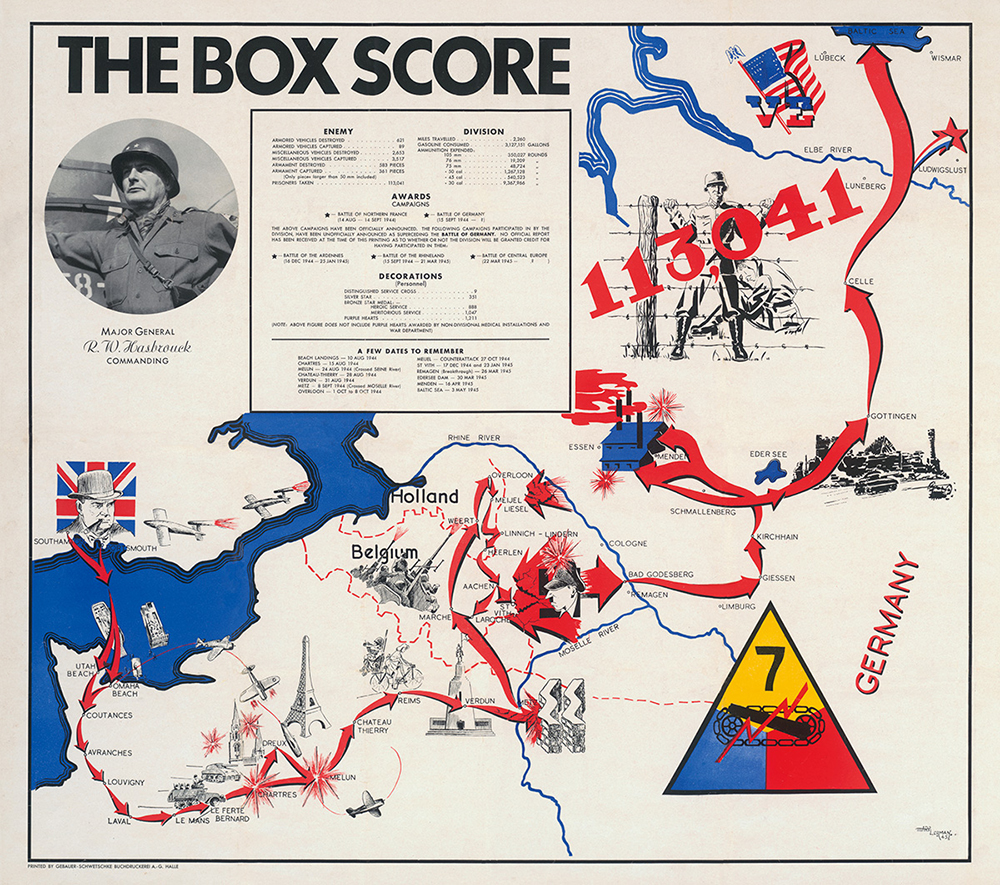
Sent north to the Netherlands, the division attacked from Oploo on September 30 to clear a corridor west of the Maas. Combat Command B took Vortum, and the division fought through the Peel Marshes and Overloon in early October before breaking off the attack. It later established a bridgehead over the Canal de Deurne and fought around Meijel, then shifted back toward the Roer, where it was preparing to attack from the Linnich area when the Ardennes offensive began.
Elements moved to St. Vith on December 16. For six days the division, reinforced by scattered infantry and other armored elements, helped hold the road center against the German advance until withdrawal was ordered on December 21. The battered division was then drawn into the Manhay crisis: Manhay fell on December 24 and was restored to Allied control on December 27 after confused fighting and counterattacks. In January the division returned toward St. Vith, attacking through mines and deep snow, taking Born, Hunningen, St. Vith, Wallerode, and the Bois de St. Vith before clearing Strauch and Steckenborn in February and entering rehabilitation.
In March 1945 the division assembled near Zulpich, cleared west-bank Rhine ground between Bonn and Remagen, crossed the Rhine, and advanced to the Dill, Lahn, and Eder. It captured the Edersee Dam intact on March 30 and then helped reduce the Ruhr Pocket, fighting at Niedersfeld, Gleidorf, and Fredeburg before organized resistance collapsed there by April 16. After assembling at Gottingen, the division joined XVIII Airborne Corps' Elbe-to-Baltic operation, moving west of Kluetz by May 3 and contacting Soviet forces in that region before hostilities ended.
(A) = attached
Sources and notes can be found on the Sources page.
View sources →