
The 82nd Airborne Division arrived in North Africa in May 1943 and soon entered combat during the invasion of Sicily. On the nights of July 9-12, the 505th Parachute Infantry Regiment and elements of the 504th Parachute Infantry dropped near Gela. The drops were widely scattered, and many aircraft encountered friendly naval and ground fire, but assembled paratroopers formed ad hoc units and fought as ground troops, helping stabilize the beachhead during the critical early phase of the operation.
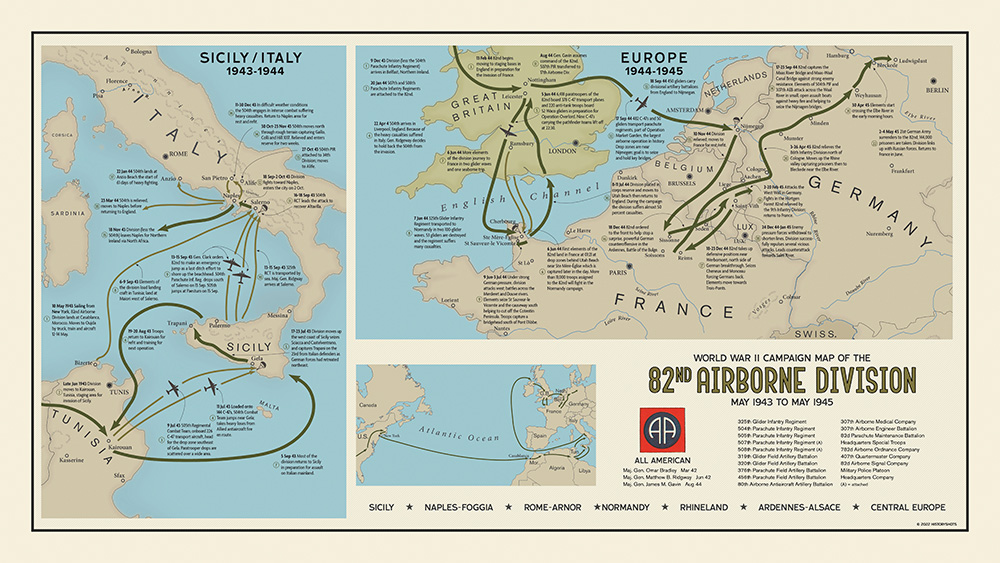
In September 1943, the division conducted airborne operations during the Salerno landings. The 504th Parachute Infantry dropped on September 13, followed by the 505th on September 14, while the 325th Glider Infantry Regiment landed by sea. These forces reinforced the threatened beachhead, and the division fought forward to Naples, entering the city on October 1. The 504th Parachute Infantry continued to see combat in the Volturno Valley and later took part in the Anzio fighting before rejoining the division, which had moved to England via Ireland in December 1943.
On June 6, 1944, the division dropped into Normandy ahead of the seaborne landings, fighting around Sainte-Mère-Église, the Merderet River, and the approaches to Utah Beach. Its regiments disrupted German reinforcement routes, helped secure the lodgment, and remained in continuous combat for over a month — clearing across the Cotentin toward Saint-Sauveur-le-Vicomte — before being relieved in mid-July.
The division's next major operation came on September 17, 1944, during Operation MARKET GARDEN. Dropping near Nijmegen, it seized key bridges across the Maas and the Maas-Waal Canal, and on September 20 the 504th Parachute Infantry crossed the Waal River in assault boats to capture the Nijmegen railroad bridge while other regiments held the surrounding ridges. Although the broader operation failed to hold Arnhem, the division held its gains and remained engaged in the Netherlands through November.
In December 1944, the 82nd was committed to the Ardennes. Fighting along the Salm River and in the northern sector of the Bulge, it blocked German advances, contested Manhay, and withdrew from the Vielsalm salient on December 25 before resuming the offensive in early January and helping compress the salient from the west.
Returning to the attack in early 1945, the division breached the Siegfried Line, crossed the Roer on February 17, and later advanced across the Rhine. In April it moved rapidly through northern Germany, attacking from the Elbe on April 30 and driving into the Mecklenburg Plain. The German Twenty-First Army surrendered to the division on May 2 near Schwerin. Its combat record spanned the full arc of the European war — from Sicily and Salerno to Normandy, Holland, the Ardennes, and the final advance into Germany.
(A) = attached
Sources and notes can be found on the Sources page.
View sources →