
The 9th Infantry Division entered combat during Operation TORCH on November 8, 1942, the 39th Infantry Regiment landing east of Algiers near Cap Hillifou, the 47th Infantry Regiment taking Safi on the Moroccan coast, and the 60th Infantry Regiment coming ashore at Mehdia while fighting to seize the Port-Lyautey airfield against stiff French resistance. Returning to Tunisia in February 1943, the 47th Infantry attempted in late March to force a gap at Djebel Berda but was repulsed with heavy losses. Shifting north, the division attacked the Jefna positions on April 23; the 60th Infantry occupied Kef en Nsour on May 2, and the 47th Infantry entered Bizerte on May 8, 1943 — one of the last major objectives taken before Axis resistance in North Africa ended. The 39th Infantry was sent into Sicily on July 15, and the full division arrived at Palermo by August 1 before driving toward Randazzo and Messina.
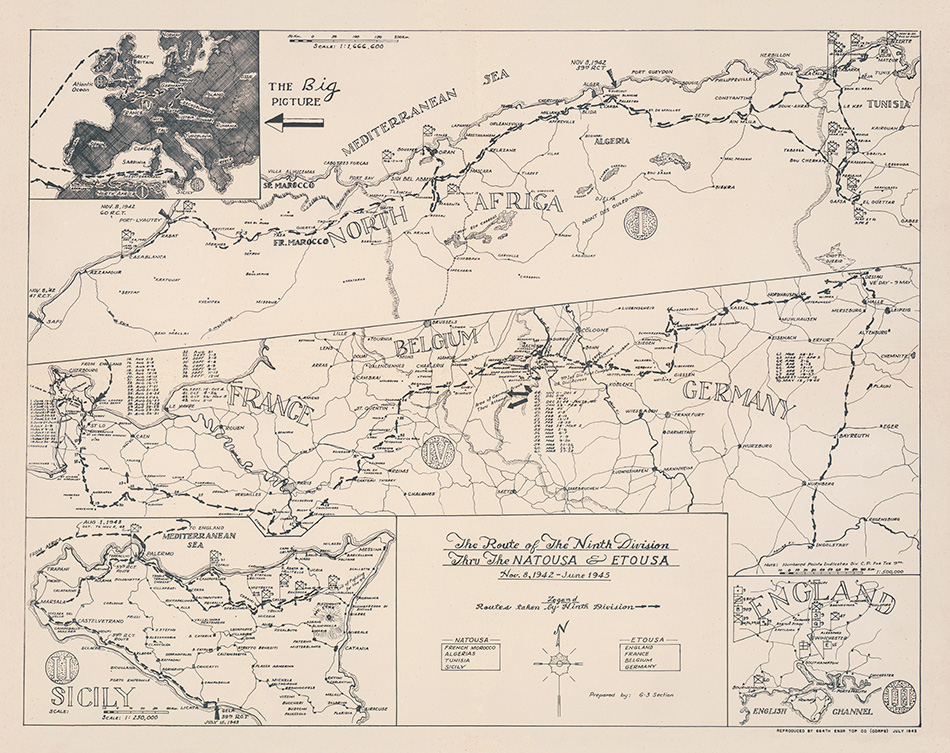
The division landed across Utah Beach on June 10, 1944. The 39th Infantry drove the Germans back to the Quineville Ridge by June 12, and on June 16 the Old Reliables attacked with four regiments — reinforced by the 359th Infantry Regiment of the 90th Infantry Division — to bridge the Douve River and seal off the Cotentin Peninsula. The 39th and 60th Infantry commenced the final assault on Cherbourg on June 19, the 39th capturing the German fortress commander and Octeville on June 26 while the 47th Infantry cracked the arsenal the following day.
After the breakout and the advance across France, the division entered the Roetgen sector and was heavily engaged in the Hürtgen Forest that autumn. In early 1945 it seized the Schwammenauel Dam on the Roer River, preventing its demolition, and crossed the Rhine through the Remagen bridgehead in March. The Old Reliables advanced to the Mulde River in April, where they held until the German surrender — their campaign extending continuously from the beaches of North Africa to the center of Germany.
(A) = attached
Sources and notes can be found on the Sources page.
View sources →