The 104th Infantry Division arrived in France in September 1944 and moved into the line with Canadian First Army near Antwerp in October, attacking on October 25 to clear the Antwerp approaches. Shifting to the Aachen sector in November, it fought through the Eschweiler-Weisweiler industrial complex in sustained close combat, Weisweiler falling on November 25 after house-to-house fighting. The division then secured the bridge at Inden and spent December fighting for the Roer's west bank, known for night attacks that denied German defenders rest and kept the front active through the winter pause.
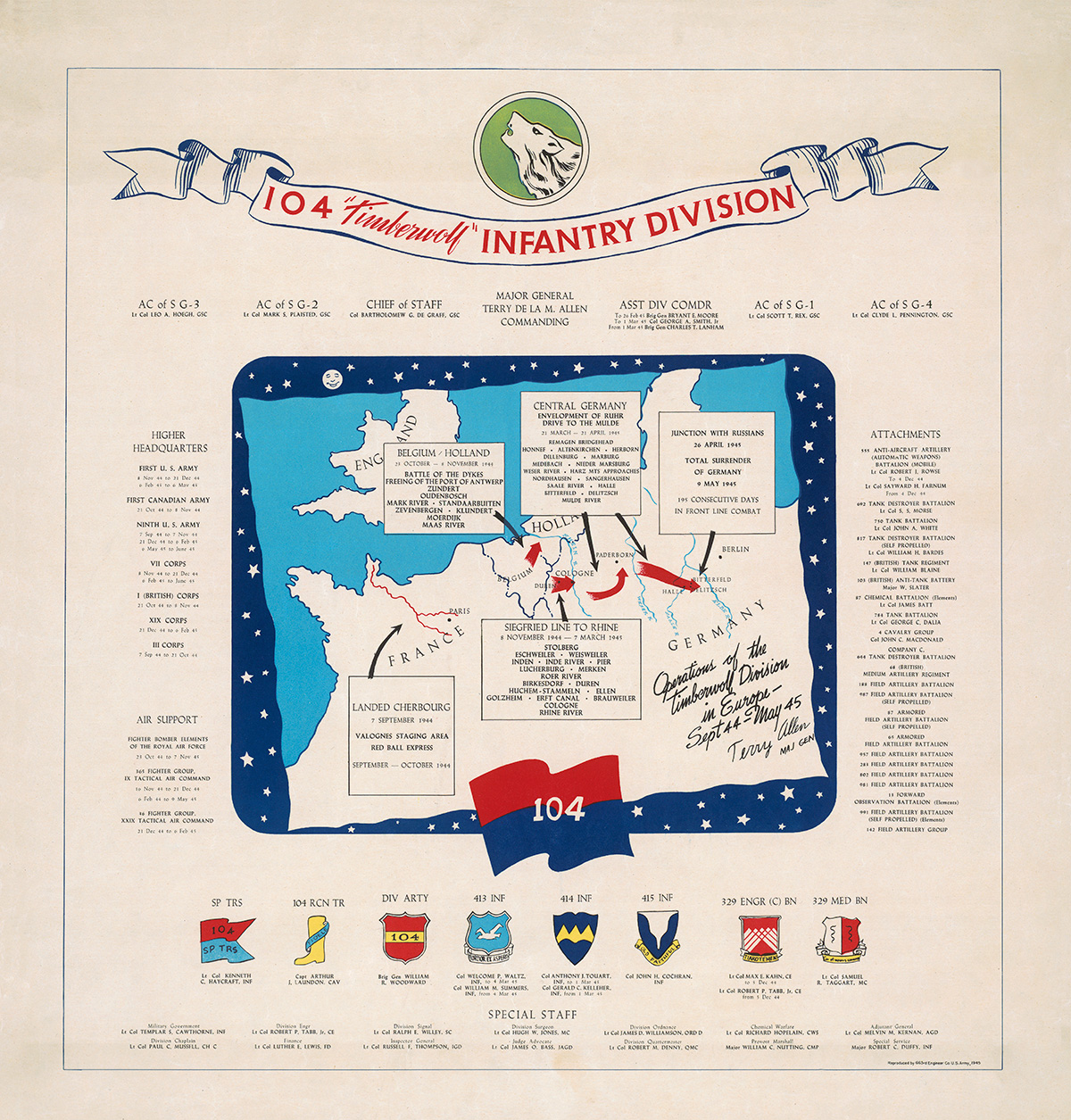
In February 1945, the 415th Infantry Regiment assaulted across the Roer at Birgel and Stommeln; the division mopped up Düren and drove toward Cologne, helping clear the west bank before crossing the Rhine at Remagen. Following the 3rd Armored Division into the Ruhr, it reduced bypassed resistance through late March before the 415th Infantry fought for Kuestelberg on April 2-3. The division crossed the Weser at Gieselwerder on April 8 and pressed east through the Harz approaches.
The Battle for Halle from April 14-19 proved the campaign's hardest urban fight — sustained house-to-house combat through the industrial city before it finally fell. The 415th Infantry captured Bitterfeld on April 20-21, and the division reached the Mulde River before making contact with Soviet forces at Pretzsch on April 26 — one of the first East-West junctions on the Western Front.
(A) = attached
Sources and notes can be found on the Sources page.
View sources →