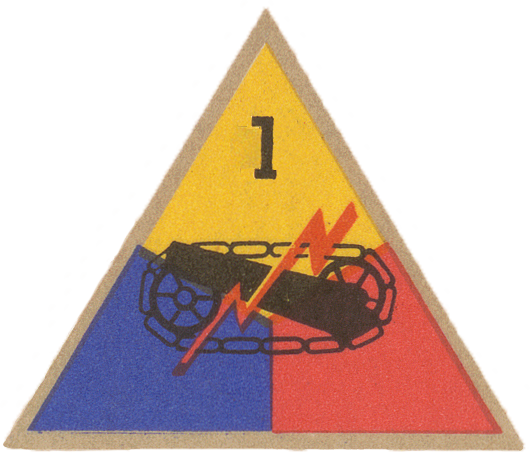
The 1st Armored Division entered combat in North Africa during Operation TORCH. Combat Command B landed east and west of Oran on November 8, 1942, entered the city two days later, and soon moved into Tunisia. Its early operations showed both the promise and the cost of American armored warfare against experienced German forces. CCB raided Djedeida airfield and fought around Tebourba and El Guessa, while Combat Command A was badly hit at Sidi Bou Zid in February 1943, with elements isolated on Djebel Lessouda, Djebel Ksaira, and Garet Hadid. Combat Command R counterattacked toward Sbeitla but was also repulsed. After the Kasserine crisis, the division recovered, fought through Maknassy and Djebel Naemia, and then joined the final northern drive, taking part in the Mateur, Djebel Achkel, and Ferryville operations before Axis forces in Tunisia surrendered.
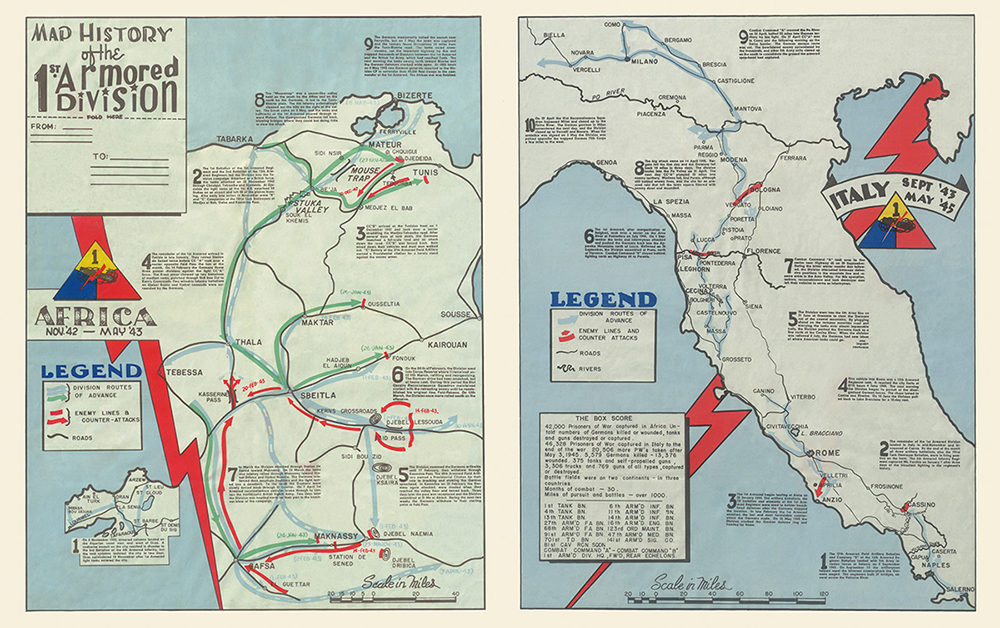
Reorganized in French Morocco, the division began arriving in Naples in late October 1943. It entered the Winter Line fighting along the Rapido in December, with the 6th Armored Infantry on Monte Lungo and a task force taking heavy losses at Monte Porchia in January. Most of the division landed at Anzio beginning January 24, 1944. Its early attempt toward the Colli Laziali stalled in mud and constricted terrain, but during the German counteroffensive it served as a counterattack force on the beachhead.
When the Anzio breakout began on May 23, CCA and CCB attacked from the beachhead and fought through the Campoleone area, suffering heavy tank losses before the German line gave way. Task Force Howze drove up Highway 6 on June 3, and the division entered Rome the next day. The pursuit north quickly became another grinding campaign. After a brief rehabilitation period, the division fought at Casole d'Elsa, crossed the Arno on September 1, cleared Monte Pisano, Altopascio, and Lucca, and then pushed into the Serchio and North Apennine fighting around Castelvecchio, Monte Liguana, Ponte a Moriano, and the Monterumici hill mass.
In March 1945 the division took Carviano and fought for Salvaro. In the April offensive it attacked toward Suzzano and Vergato, advanced astride the Samoggia, and crossed the Panaro with Combat Command B as Combat Command A bypassed Modena. CCA reached the Po at Guastalla and Luzzara on April 23, and the division crossed during the final collapse, taking positions near Milan and reconnoitering to the Ticino. By April 28 it had reached Lake Como; German forces in Italy surrendered effective May 2.
(A) = attached
Sources and notes can be found on the Sources page.
View sources →