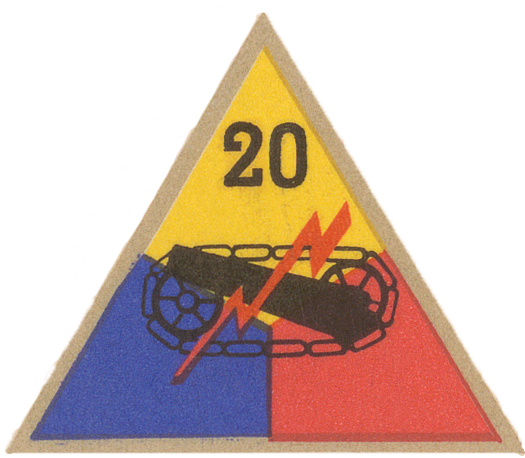
The 20th Armored Division landed at Le Havre on February 17, 1945, and trained at Buchy while the older armored divisions were already deep in Germany. It reached Langendernbach on April 10, moved to Wuerzburg on April 23, and entered combat only in the war's final phase. Its first engagement came at Dorf on April 25, after which the division assembled near Deiningen for the southward drive across Bavaria.
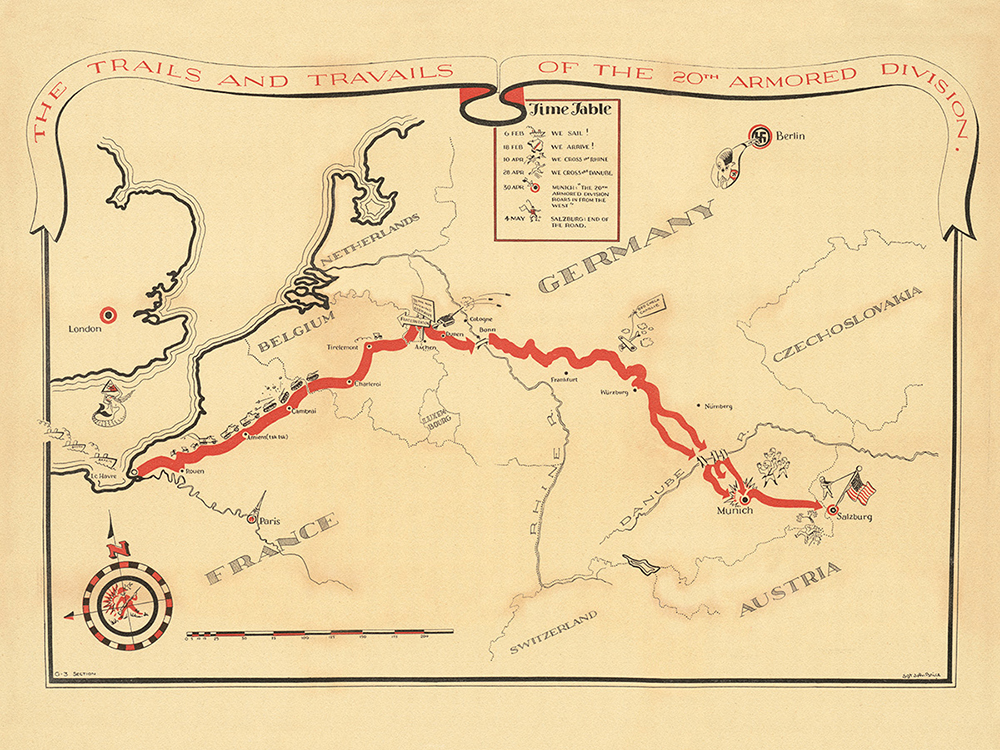
On April 28 the division attacked through the lines of the 42nd and 45th Infantry Divisions and crossed the Danube to open the drive on Munich. The next day XV Corps raced toward the Bavarian capital with the 20th Armored spearheading and the 3rd, 42nd, and 45th Infantry Divisions also in assault. Green Book context makes the setting plain: Munich was both a major city and a symbolic center of Nazism, but it was also a city where anti-Nazi groups and civilians tried to prevent a destructive last stand. Their efforts helped save bridges and assisted the American entry, but organized resistance remained in parts of the city.
The 20th Armored's role was therefore important but not solitary. As infantry divisions closed from several directions, the division cleared strong opposition in assigned sectors on April 29-30. Other XV Corps units reached the city center and fought through stubborn pockets, including SS-controlled installations, while the 20th helped break the armored route into the capital. By nightfall on April 30, Munich was secure.
After Munich, the division continued southeast in the general rush toward the Alpine approaches. It crossed the Inn River at Wasserburg on May 3 and entered Traunstein on May 4. Green Book accounts of this phase describe less a set-piece pursuit than a rapid motor movement under tactical conditions, with surrendering German units clogging the roads. The 20th was moving toward Salzburg when hostilities were declared ended. Its campaign was short, but it placed the division at the center of the final Danube-Munich-Salzburg drive.
(A) = attached
Sources and notes can be found on the Sources page.
View sources →