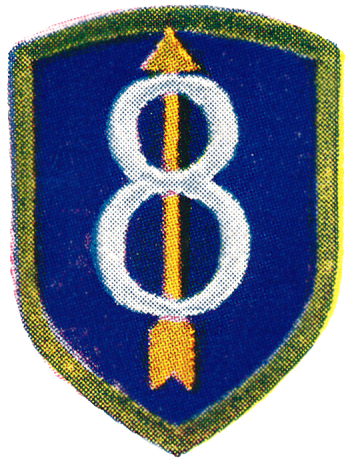
The 8th Infantry Division landed across Utah Beach on July 3, 1944 and entered combat in the hedgerow terrain between the 79th and 90th Infantry Divisions. It cut the Lessay–Périers road on July 26, and the 13th Infantry Regiment pushed through Rennes on August 8 as the Allied breakout gathered momentum. The division then turned into Brittany, the 121st Infantry Regiment attaching temporarily to the 83rd Infantry Division for the attack on the fortified port of Dinard; the entire Golden Arrow Division joined the assault on August 14, and Dinard fell on August 16. Shifting to Brest, the division attacked the outer fortifications on August 25 after an artillery preparation and stormed the fortress itself on September 8. After clearing the Crozon Peninsula and taking Crozon on September 19, the division had completed one of the most methodical reduction efforts of the Western European campaign.
Moving east by rail and motor across France, the division relieved the 28th Infantry Division in the Vossenack–Schmidt area on November 19. After artillery preparation, the 121st Infantry attacked into the Hürtgen Forest on November 21, where the Germans had already bloodied the 4th Infantry Division. Together with the 13th Infantry, the 121st had secured the deep forest by November 28 despite heavy losses and repeated counterattacks. The 28th Infantry Regiment and 121st Infantry then cleared the Brandenberger Wald in early December to open a corridor for an armored drive, before the division spent the latter part of the month reducing a German pocket south of Obermaubach.
The Golden Arrow division crossed the Roer on February 23, 1945, reached the Rhine near Rodenkirchen on March 7, helped destroy enemy forces in the Ruhr Pocket in April, and then, under British Second Army operational control, crossed the Elbe on May 1 and reached Schwerin as the war in Europe ended.
(A) = attached
Sources and notes can be found on the Sources page.
View sources →