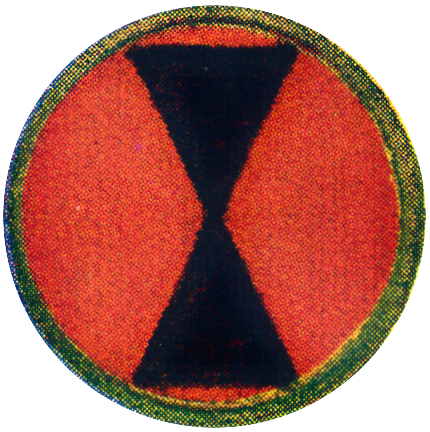
The 7th Infantry Division began its combat career in the Aleutians. On May 11, 1943, the 17th Infantry Regiment landed in dense Arctic fog on Attu Island to begin the assault against the Japanese garrison. The 32nd Infantry Regiment joined the attack the following day, and together the two regiments seized the strongly held Clevesy Pass on May 21 across frozen tundra and cleared Fish Hook Ridge by May 27 before organized Japanese resistance collapsed at the end of the month. In August, the 17th and 184th Infantry Regiments landed on Kiska to find the Japanese had evacuated the island.
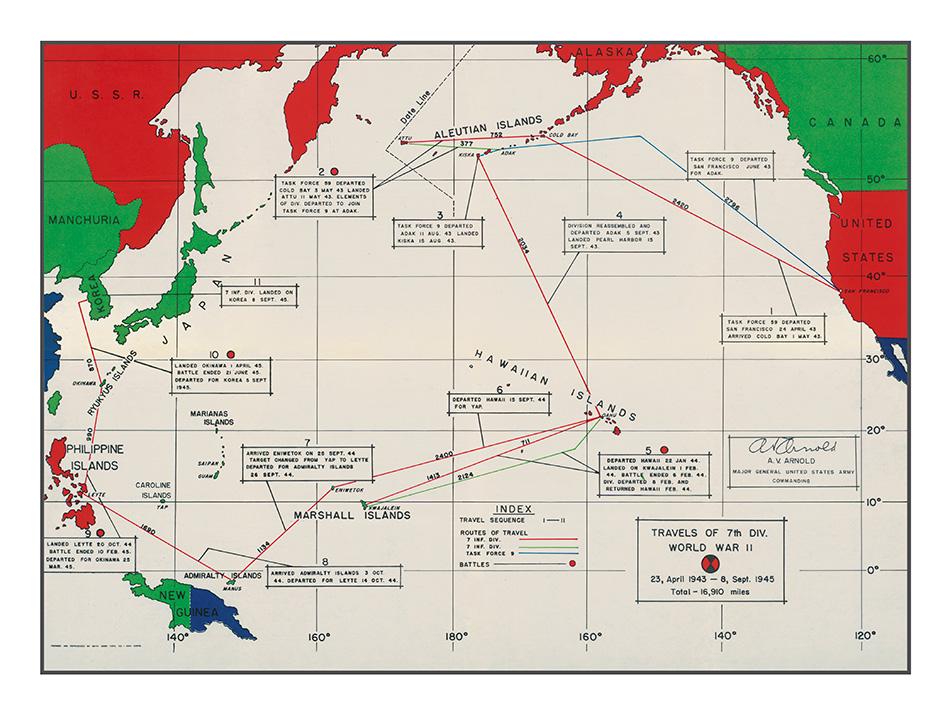
After intensive training in Hawaii, the division departed in January 1944 to assault the Marshall Islands. The 17th Infantry landed on outlying islands of Kwajalein Atoll on January 31, and the division then fought for the principal defended islands of the atoll. The 184th Infantry broke through the Japanese blockhouse sector on February 3, and the atoll was secured by February 5.
The division landed on Leyte in the Philippines on October 20, 1944. The 32nd Infantry seized the contested Buri airstrip on October 27 and the 17th Infantry took Dagami after hard fighting on October 30. The Battle of Shoestring Ridge opened on November 23 when Japanese forces struck the thinly spread 32nd Infantry along the Palanas River; reinforced by the 184th Infantry, the division repelled repeated assaults in bamboo thickets over several days before stabilizing the line. Driving north from Damulaan along the Ormoc corridor, the division linked with the 11th Airborne Division on December 15, dividing Japanese forces on the island.
In April 1945, the Hourglass Division landed on Okinawa on April 1 and advanced rapidly across the island, the 17th Infantry reaching the east coast and severing the island during the initial push. The division then became heavily committed to the prolonged fighting against the main Japanese defensive line in the south, among the costliest combat of the Pacific war. Organized resistance on Okinawa collapsed by late June, completing a campaign that stretched from the Arctic tundra of the Aleutians to the final decisive battles of the Pacific.
(A) = attached
Sources and notes can be found on the Sources page.
View sources →