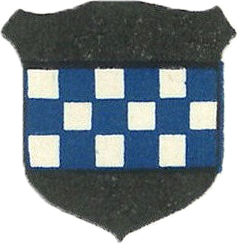
The 99th Infantry Division arrived in Belgium in November 1944 and entered a quiet sector north of the Roer between Schmidt and Monschau. On December 16, the German Ardennes counteroffensive struck its front with full force. Holding at Höfen against the most direct assault, the division fell back under pressure south of its line but withdrew to Elsenborn Ridge — high terrain that blocked the northern route toward Liège and the Meuse crossings. For over a week its regiments absorbed repeated German attacks while denying access to the lateral roads essential to the German plan. The 393rd Infantry Regiment bore the weight of the Elsenborn defense and held through the counteroffensive's most intense phase, anchoring the northern shoulder of the Bulge alongside the 2nd Infantry Division.
After the crisis passed, the division returned to the offensive in early February. The 393rd Infantry attacked into the Elsenbuchel Woods and cleared the Monschau Forest before crossing the Erft River at Glesch on March 2 and racing to the Rhine, reaching Grimlinghausen on March 5. The division crossed at Remagen and took over the bridgehead's southern flank, the 394th Infantry clearing Honnigen in heavy fighting by March 16. Pressing through the Wied River line, it drove east behind armor toward the Dill and Lahn rivers before turning to participate in the Ruhr Pocket's reduction — entering Iserlohn when its garrison surrendered in April. The division then swept south through Bavaria, crossing the Altmühl, Danube, and Isar before reaching the Inn River when hostilities ended on May 7.
(A) = attached
Sources and notes can be found on the Sources page.
View sources →