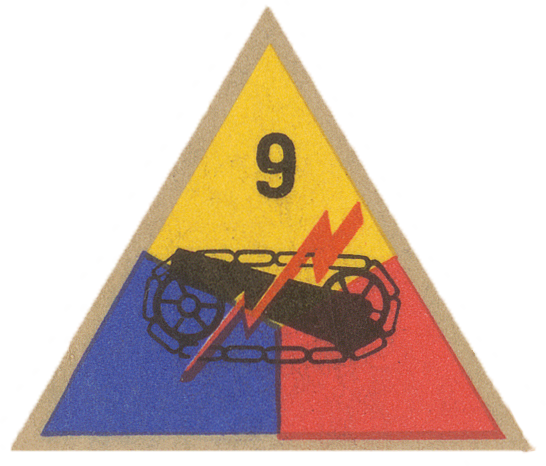
The 9th Armored Division landed in France on October 3, 1944, and first held a quiet sector along the Luxembourg-German frontier. Its first major battle came in the Ardennes, where the division was broken into scattered combat commands rather than committed as a unified armored force. Combat Command B was sent into the St. Vith fight, helping delay German forces near Winterspelt, the Our crossings, and the southern side of the St. Vith perimeter. Combat Command A fought along the Sauer near Beaufort, Waldbillig, Ermsdorf, and the southern shoulder of the German attack, while Combat Command R set roadblocks on the St. Vith-Bastogne highway and was badly battered around Lullange, Allerborn, Longvilly, and the approaches to Bastogne. By late December the division had paid heavily, but its dispersed stands had bought time at several threatened road centers.
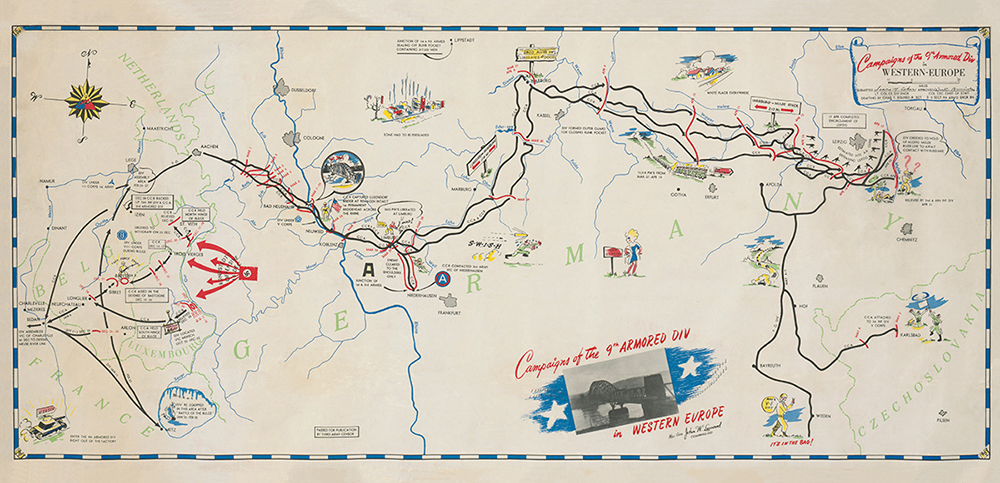
After rehabilitation in January and training in February, the division returned to the offensive across the Roer on February 28, 1945. Its combat commands pushed through Wollersheim, Friesheim, Niederberg, the Erft, and Euskirchen as First Army drove toward the Rhine and Ahr. On March 7, Combat Command B's Task Force Engeman reached the heights above Remagen and found the Ludendorff railroad bridge still standing. German demolition efforts damaged but failed to drop it, and Company A, 27th Armored Infantry Battalion, led by Lt. Karl Timmerman, stormed across under fire. The seizure gave the Allies their first intact Rhine crossing and turned a hoped-for river-line defense into an emergency German bridgehead battle.
The division then helped expand and exploit the Remagen bridgehead. In late March it cleared between the Rhine and Wied, drove through the 2nd Infantry Division toward the Lahn, and reached Limburg and Diez before pushing toward Idstein. Continuing north, it secured crossings over the Eder and then established a Diemel bridgehead in the Warburg area.
In April the 9th Armored spearheaded V Corps' eastward drive. Committed on April 10, it advanced through Naumburg, the Weisse-Elster, and the Saale approaches, then struck the heavy flak belt protecting the Leipzig-Merseburg industrial region. Shifted southeast, the division bypassed Leipzig and drove to the Mulde. Combat Command R seized bridges near Colditz and crossed there, freeing Allied prisoners from Colditz Castle. After mopping up along the Mulde, the division moved to reserve; in May, CCA was attached to the 1st Infantry Division for the drive toward Karlsbad and reached Rudolec when hostilities ended.
(A) = attached
Sources and notes can be found on the Sources page.
View sources →