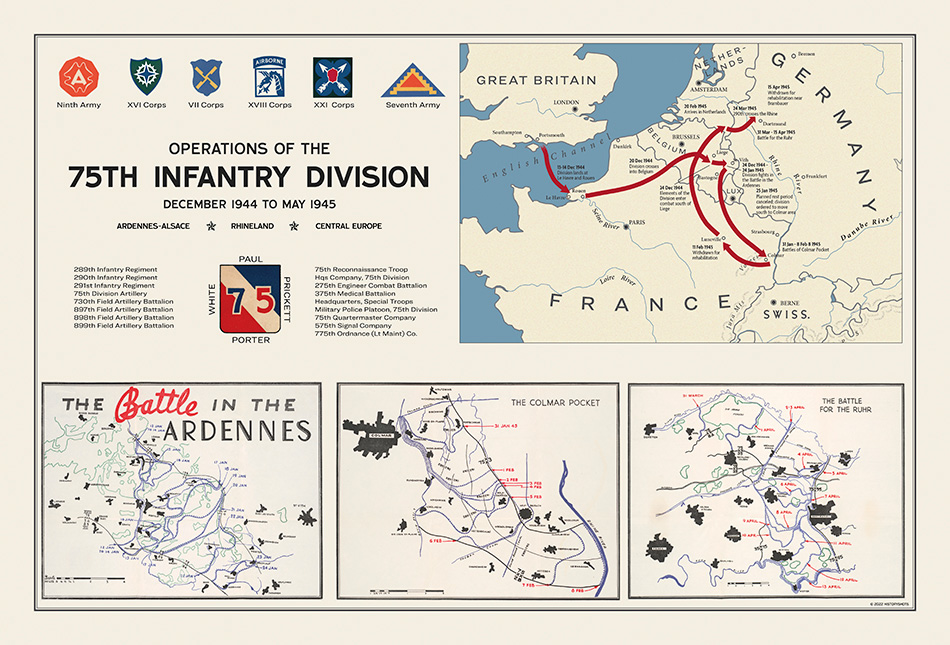
The 289th Infantry Regiment was activated with the 75th Infantry Division at Fort Leonard Wood on April 15, 1943, trained through Louisiana and Kentucky, and landed in France on December 13, 1944. Within days it moved through Holland into Belgium and was attached to the 3rd Armored Division during the Ardennes crisis. Its first combat came in the broken, snow-covered country around Grandmenil and the Aisne River. On Christmas Day 1944 the 3rd Battalion was shifted from the planned regimental attack to block the roads west and northwest from Grandmenil, where German armor from the 2nd SS Panzer Division tried to open a route toward Erezee. Company K helped halt a Panther-led column, and the regiment then pressed toward the Aisne and the wooded hill mass southwest of Grandmenil. Company L later helped stop movement on the Mormont road. In the confused Sadzot fight of December 27-29, the 1st and 2nd Battalions formed opposite sides of a gap that German infantry exploited before the line was restored.
After the Ardennes, the 289th fought with the 75th Division in Alsace. The division crossed the Colmar Canal near Andolsheim on February 1, 1945, advanced through the forest and canal defenses south of Colmar, and reached the Rhine near Neuf-Brisach before being withdrawn to Luneville. The regiment reentered Belgium and Holland, served briefly under British VIII Corps, and entered Germany on March 10.
In April the 289th and 290th attacked through the 8th Armored Division's stalled positions and reached the Dortmund-Ems Canal near Datteln. The regiment then fought across the canal, helped clear the approaches to Dortmund, and moved with the division to the Ruhr at Witten. It ended the war on occupation and military-government duty in Westphalia after three combat phases: the Ardennes, the Colmar Pocket, and the Ruhr.
Sources and notes can be found on the Sources page.
View sources →