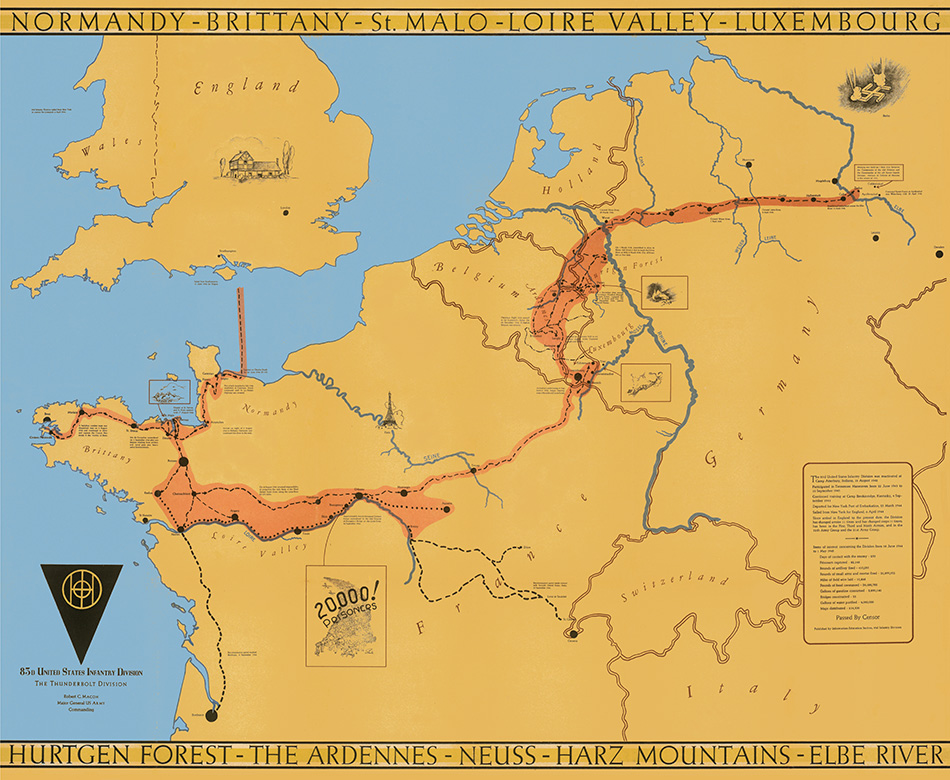
The 329th Infantry landed with the 83rd Infantry Division in France on 19 June 1944 and entered combat in the hedgerow fighting toward Periers. After the division crossed the Taute during the Cobra breakout, the regiment joined the Brittany turn and became central to the reduction of St. Malo. While the 330th and 331st fought Dinard and the city approaches, the 329th operated around St. Servan and Parame, then took responsibility for the Citadel, the fortress core that resisted artillery, air attack, engineers, and close assault until 17 August.
After Brittany, the 83rd screened the Loire and accepted the surrender of Group Elster. In Luxembourg the 329th led the Moselle-Sauer clearing mission: Company C reached Grevenmacher on 1 October, the regiment cleared the town after artillery and fighter-bomber support on 5 October, and its 3rd Battalion took Echternach on 7 October after nearly a week outside the town. In December the regiment entered the Roer approach battles, attacking through Hof Hardt and Guerzenich, then Birgel, while the division cleared the west bank near Dueren. During the Ardennes counteroffensive it attacked Rochefort and later fought through Petite Langlir, Langlir, Honvelez, Bovigny, Courtil, and the Bois de Ronce.
In March 1945 the 329th helped drive to the Rhine, with Neuss falling as the division reached the river. In April it became one of the 83rd's fastest-moving elements, crossing the Weser at Bodenwerder, taking Halle, reaching the Elbe at Barby on 12 April, and joining the 331st in the Elbe bridgehead the next day. It later occupied Zerbst as cavalry patrols pushed east toward Soviet forces. Across those operations it shifted from fortress reduction to river-line clearing, forest combat, and open pursuit.
Sources and notes can be found on the Sources page.
View sources →