The 32nd Armored Regiment served as one of the tank regiments of the 3rd Armored Division. Its successor lineage traces Company A to the Regular Army's January 13, 1941, constitution of Company A, 2d Armored Regiment, an element of the 3rd Armored Division, and to activation at Camp Beauregard, Louisiana, on April 15, 1941. The company was redesignated Company A, 32nd Armored Regiment, on May 8, 1941. Stanton's division organization confirms the 32nd Armored Regiment in the 3rd Armored Division's wartime armored structure.
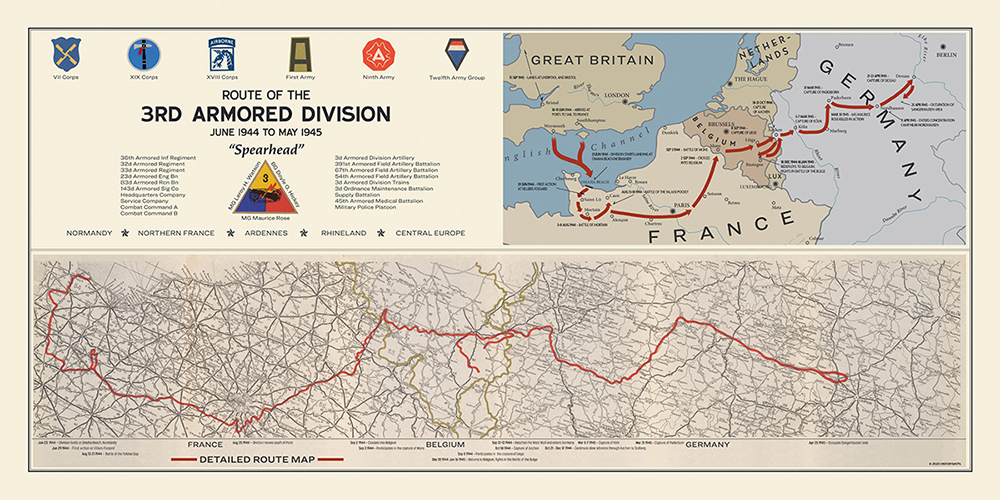
The regiment fought in the European Theater with the 3rd Armored Division. After the division reached Normandy in June 1944, its armored columns entered combat north of St. Lo, crossed into the Airel bridgehead, and joined the breakout through Marigny, Gavray, Brecey, St. Pois, Domfront, Ranes, and Fromenthal. During the late-August pursuit beyond the Seine, Staff Sergeant Lafayette G. Pool of the 32nd Armored Regiment commanded the lead tank of an armored column for three days. His tank crew destroyed German tanks, antitank guns, and vehicles during the pursuit, an action for which he received the Distinguished Service Cross.
The 32nd Armored Regiment's later record follows the 3rd Armored Division through Belgium, the West Wall, the Ardennes, and central Germany. In September 1944 the division seized Huy, cleared Liege, reached Verviers, and fought into the Siegfried Line around Roetgen, Stolberg, Geisberg Hill, Weissenberg Hill, Muensterbusch Hill, and the Aachen approaches. During the Ardennes counteroffensive the division defended and counterattacked around Eupen, Stoumont, La Gleize, Hotton, Grandmenil, Sadzot, Bihain, Gouvy, and Beho. In 1945 it advanced from the Roer and Rhine operations through Cologne, the Ruhr Pocket, the Weser, the Mulde, and Dessau. The successor lineage credits the regiment's World War II service in Normandy, Northern France, Rhineland, Ardennes-Alsace, and Central Europe and lists a Presidential Unit Citation for the Siegfried Line.
Sources and notes can be found on the Sources page.
View sources →