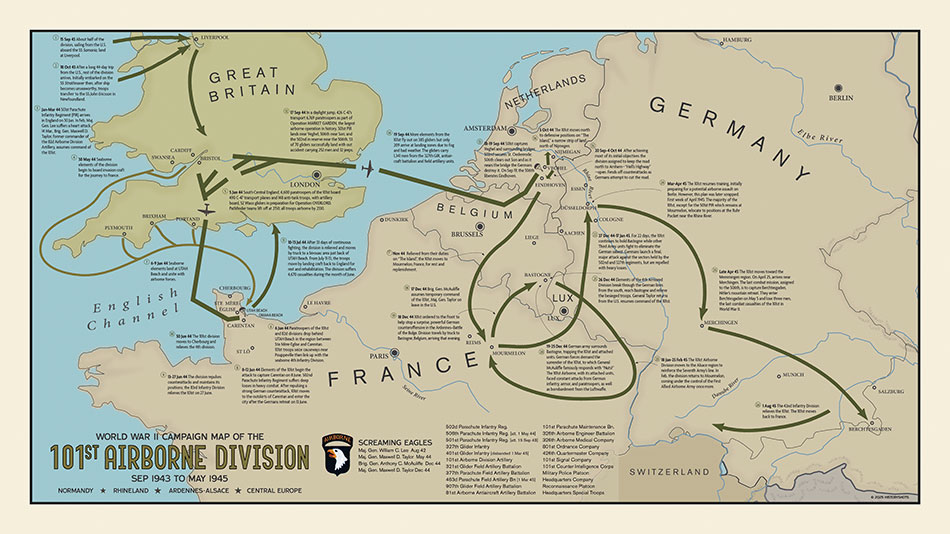
The 501st Parachute Infantry Regiment was a separate airborne regiment attached to the 101st Airborne Division shortly before the Normandy invasion. It jumped on June 6, 1944, and fought in the division's mission behind Utah Beach, including the effort to control the Douve River locks at La Barquette and hold the northern approaches to Carentan. During the Carentan operation the regiment shifted from defensive positions north of the Douve into the Brevands bridgehead. On June 12 it advanced east of the 327th Glider Infantry in the left wing of General McAuliffe's envelopment, linked with the 506th Parachute Infantry near Hill 30, and then pushed toward the Periers road. The following day, after the German counterattack toward Carentan, the 501st helped restore the line along the Baupte-Carentan-Periers road.
The regiment made its second combat jump on September 17, 1944, near Veghel during Operation Market-Garden. Its battalions seized the Aa River and Willems Canal bridges, took Eerde, and blocked Hell's Highway between Veghel and St. Oedenrode. When German forces struck the corridor from east and west on September 22, the regiment became part of the improvised Veghel defense. It then fought around Wijbosch, Eerde, and the sand dunes near Eerde as the division struggled to keep the road open.
Sent from France during the Ardennes emergency, the 501st entered the Bastogne perimeter in December. It held an eastern sector from the Bourcy-Bastogne rail line toward Neffe and met repeated German probes and attacks while the division was encircled. After the corridor to Bastogne opened, the regiment remained in the perimeter through the January reduction of the salient, then served on the Moder River line, in the Ruhr occupation zone, and in the final movement into Germany and Austria.
Sources and notes can be found on the Sources page.
View sources →