The 66th Infantry Regiment (Light Tanks) was a short-lived armored-force designation that became a combat regiment under another name. Activated at Fort Benning, Georgia, on January 15, 1940, and assigned to the 2nd Armored Division, it moved to Camp Beauregard for maneuvers in May and returned to Fort Benning in June. On July 15, 1940, it was redesignated as the 66th Armored Regiment (Light), and its World War II combat record continued under that armored designation.
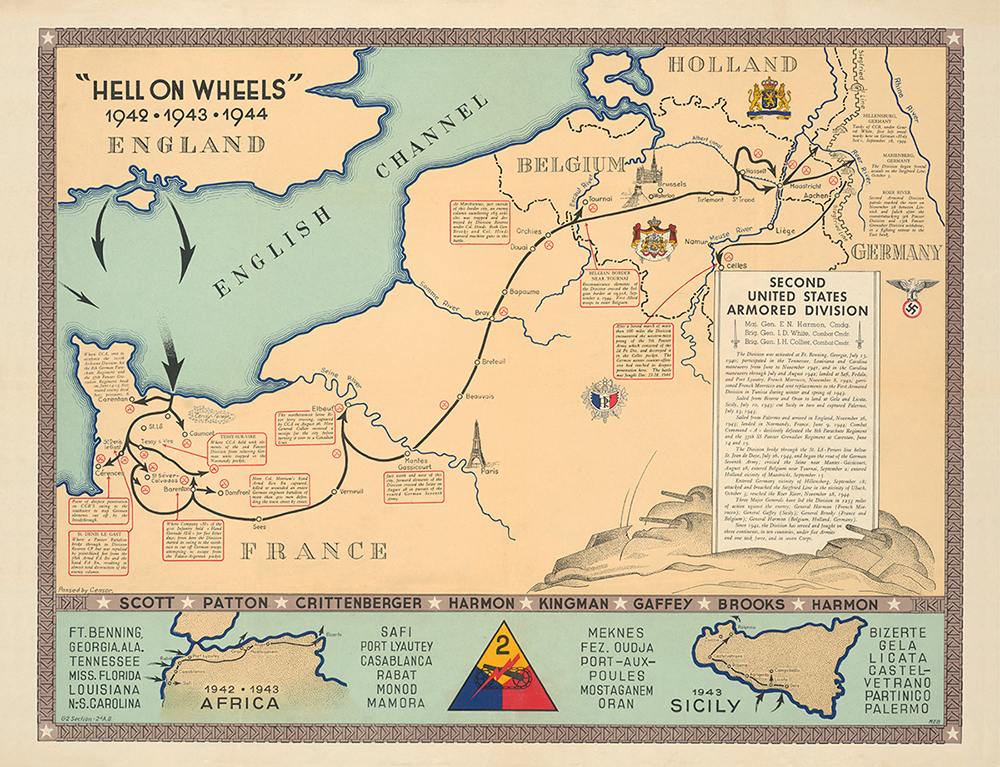
Elements of the 66th Armored Regiment landed with the 2nd Armored Division during Operation TORCH in November 1942. In Sicily the regiment formed a central part of Combat Command A. During the push from the Gela-Licata beachhead toward Naro and Canicatti, its tanks worked with the 41st Armored Infantry Regiment and supporting artillery to open roads inland and support the exploitation that followed. The regiment later trained in England with the division for the Normandy invasion.
After landing in France on June 9, 1944, the 66th Armored Regiment fought in Operation COBRA and the breakout across Normandy. Its medium tank companies formed combined-arms task forces with infantry from the 22nd Infantry and 41st Armored Infantry, protecting Combat Command A's flank in the Moyon, Villebaudon, Percy, and Tessy-sur-Vire fighting. The regiment then advanced through northern France into Belgium, Holland, and Germany. In the Wurm River and Roer approaches, elements of the regiment fought at Puffendorf, Ederen, and Merzenhausen, often paired with armored infantry and attached infantry battalions against antitank ditches, artillery, and German armor. Shifted to the Ardennes in December, the regiment helped blunt the German drive and later resumed the advance into Germany, crossing the Roer and Rhine and moving with the 2nd Armored Division toward Lippstadt, the Weser, the Leine, and the Elbe.
Sources and notes can be found on the Sources page.
View sources →