
The 5th Infantry Division arrived at Utah Beach on July 11, 1944, assumed defensive positions near Caumont, and attacked on July 26 to exploit the Saint-Lô breakthrough. Sweeping east, it took Angers on August 10, crossed the Seine at Montereau on August 24, and established a bridgehead over the Meuse at Verdun as Third Army drove toward Germany.
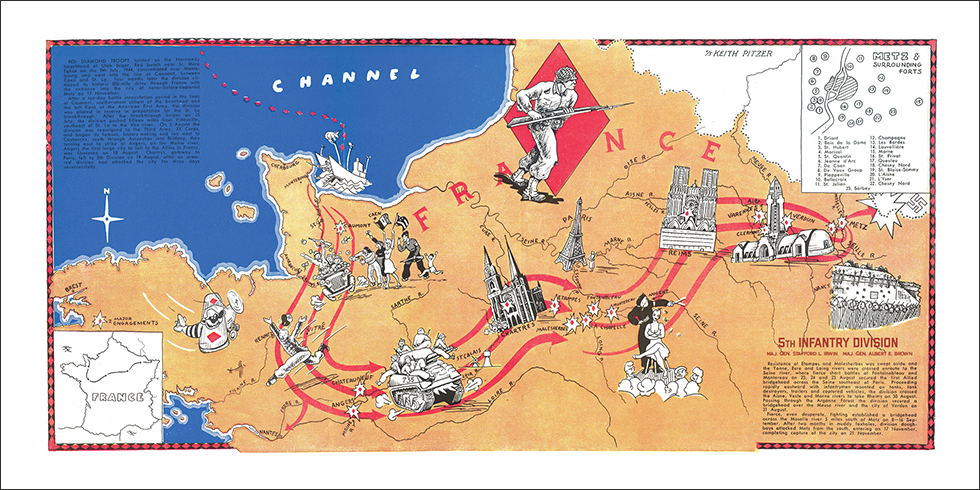
The division opened the battle for Metz on September 7, the 11th Infantry Regiment pushing up the Meuse heights at Dornot while the 2nd Infantry Regiment battered the city's outer fortifications along the Moselle. Engineers bridged the river under persistent shellfire while German forces counterattacked continuously to collapse the crossing. The division attacked Fort Driant on September 27, the 11th Infantry forcing into the bastion's outer edges on October 3 before defenders emerging from tunnels drove them back in costly close combat. After a pause to reorganize, the Red Diamond returned to the assault on November 12. Over the following days the 10th Infantry Regiment reduced Fort Aisne and Fort Queuleu while the 11th Infantry took Fort Verdun and Fort Saint-Privat. On November 18 the 10th and 11th Infantry pushed into Metz itself, the 2nd Infantry closing the encirclement the following day. Rearguard resistance inside the city was eliminated by November 22, and the fortifications that had defied the division for more than two months finally passed into American hands.
During the Ardennes period the division helped contain the southern flank of the German offensive alongside the 4th Infantry Division before returning to the general advance. In March 1945 it crossed the Rhine at Oppenheim as part of Third Army's drive east and helped establish a major bridgehead. Driving through central Germany, the Red Diamond reached Czechoslovakia in the final days of the war. Its campaign was defined above all by the deliberate and costly reduction of Metz — one of the most formidable fortified positions on the western approaches to Germany.
(A) = attached
Sources and notes can be found on the Sources page.
View sources →