
The 6th Infantry Division entered combat in Dutch New Guinea in June 1944. On June 20, the 20th Infantry Regiment began its attack toward Lone Tree Hill from the Tirfoam River, advancing against intense Japanese defensive fire from cave and bunker positions cut into steep terrain. The regiment gained the crest on June 22, only to face relentless counterattacks; simultaneously, the 1st Infantry Regiment landed by sea just west of the position to outflank the defenders. By June 27 the 63rd Infantry Regiment had mopped up the Japanese forces in the Lone Tree Hill vicinity, and the division secured the Maffin Bay area by mid-July. On July 30 the 1st Infantry assaulted Sansapor in the Vogelkop Peninsula against no resistance, complete surprise achieved by omitting the preparatory bombardment. The 63rd Infantry secured the adjacent undefended islands of Middleburg and Amsterdam.
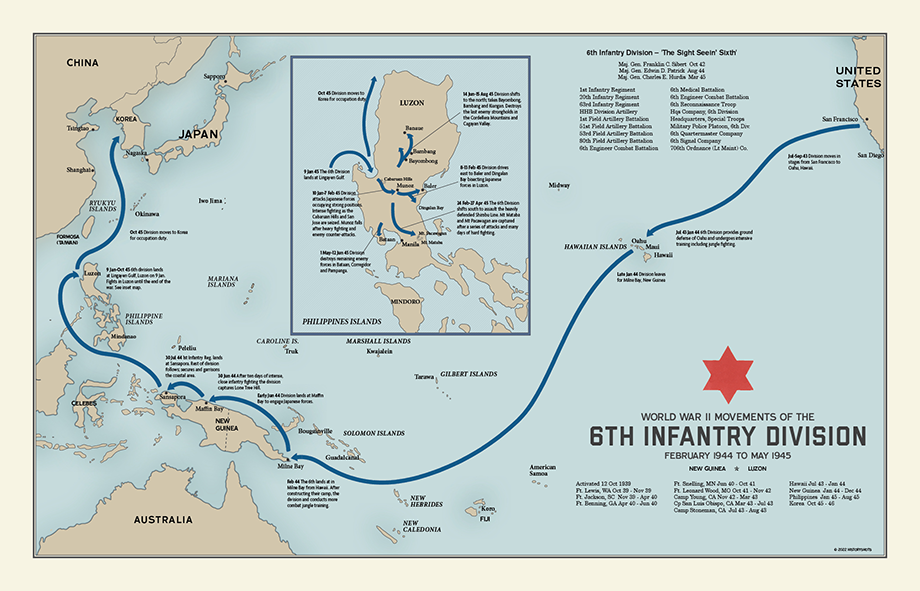
In January 1945, the division landed at Lingayen Gulf on Luzon. It fought through the Cabaruan Hills and on February 4 the 1st Infantry seized San Jose, the Highway 5 gateway to the Cagayan Valley. The 20th Infantry eliminated escaping Japanese columns at Muñoz over several days of fighting, completing the battle on February 7. The division then drove east across Luzon, reaching Dingalan and Baler Bays to bisect Japanese forces on the island, and elements operated on Bataan in mid-February to cut the peninsula from Abucay to Bagac.
The Sight Seein' Sixth shifted to the Shimbu Line northeast of Manila in late February 1945, the 63rd Infantry seizing Montalban and the 20th Infantry advancing on the heights near Mataba. Fighting along the Shimbu Line proved among the most difficult of the Luzon campaign, as Japanese defenders occupied mutually supporting positions in rugged mountain terrain and repelled American advances repeatedly before being displaced ridge by ridge. The division remained in action through the end of organized resistance on Luzon and continued operations against isolated Japanese forces until Japan's surrender.
(A) = attached
Sources and notes can be found on the Sources page.
View sources →