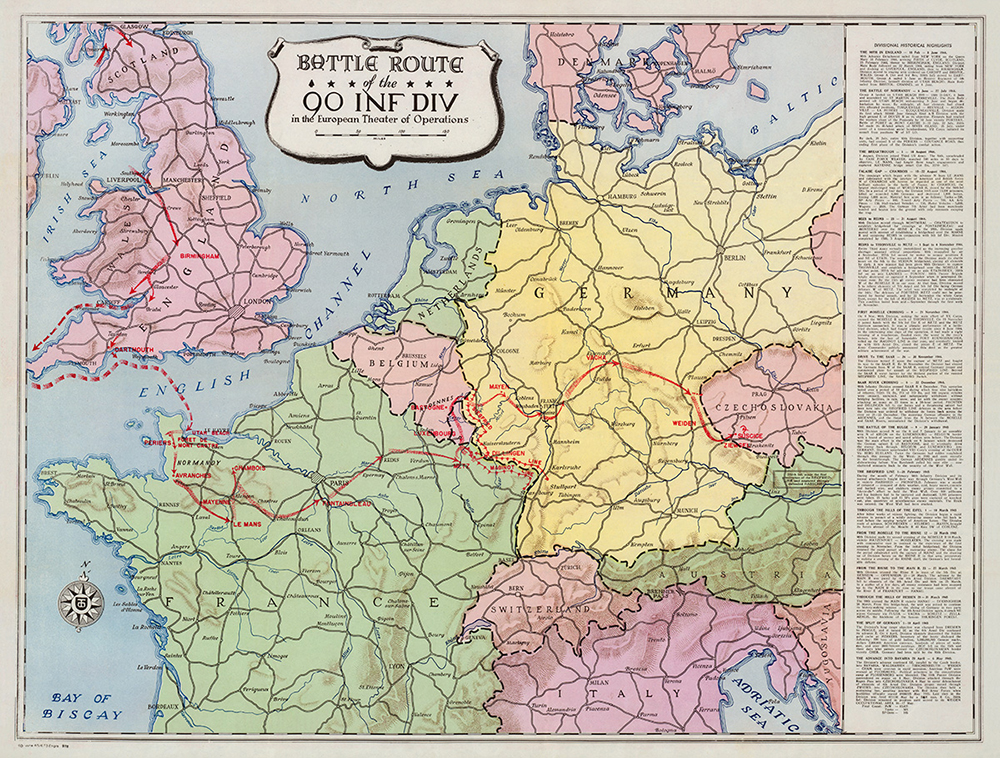
The 359th Infantry Regiment was organized at Camp Barkeley, Texas, on March 25, 1942, trained with the 90th Division, and departed New York on March 24, 1944. It reached England on April 5 and, attached to the 4th Infantry Division, assaulted Utah Beach on June 6. Released to the 90th Division after the first Normandy days, it was briefly attached to the 9th Division on June 16-17.
After joining the 90th west of the Merderet, the 359th entered the hedgerow fighting between the 357th and 358th. In July it carried the division's main right-hand effort toward Mont Castre, fought onto the north and northeast slopes, and on July 6 used a wide envelopment that helped force the German withdrawal from the hill mass. During the August battle to close the Falaise-Argentan gap, the regiment fought at La Bourg-St. Leonard and in the Foret de Gouffern; its 2nd Battalion was prominent in the last pocket fighting, where German columns tried to escape through the narrowing gap.
In Lorraine the 359th attacked Fort Jeanne d'Arc in September and was stopped along the Gravelotte-St. Hubert Farm road. It crossed the Moselle with the 358th in November, reached the Nied at Conde-Northen, and occupied Fremersdorf on the Saar's west bank. In the Dillingen bridgehead, it held the north front, fought through pillboxes to link with the 358th, and on December 18 its 3rd Battalion joined the final city attack. It reentered Germany on January 31 with the division during the winter offensive. In 1945 it took Gros Langenfeld after the Our crossing, cleared bypassed pillboxes near Habscheid, and later served with the 4th Armored Division and 26th Division during the spring pursuit. The regiment entered Czechoslovakia on May 7 and received Vseruby's surrender as hostilities ended.
Sources and notes can be found on the Sources page.
View sources →