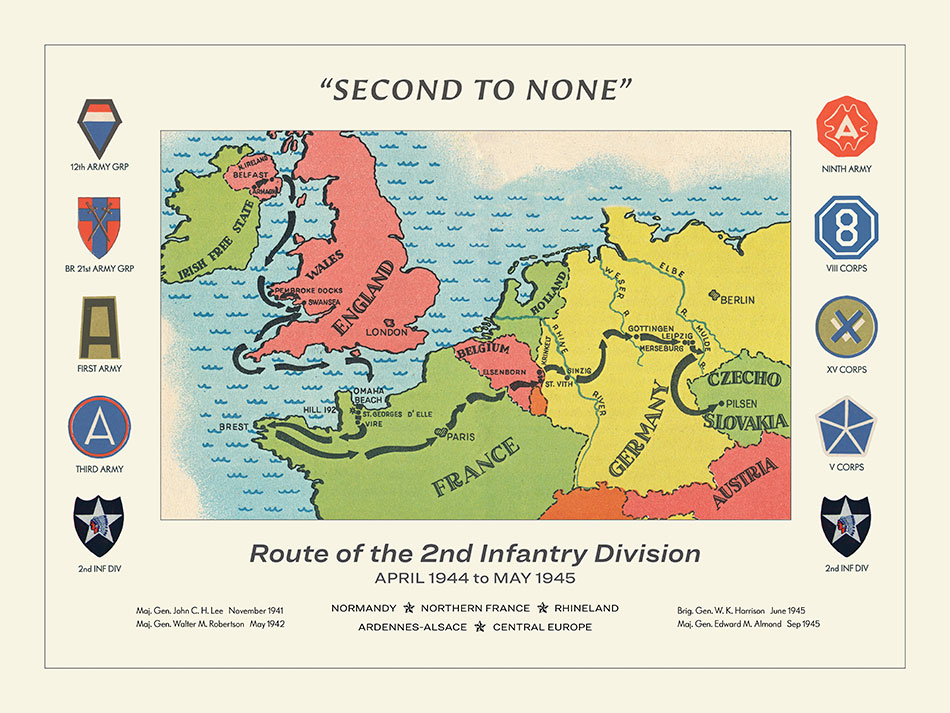
The 38th Infantry Regiment joined the 2nd Infantry Division before World War II after earlier service with the 3rd Division at Fort Douglas. It moved through Camp Bullis, Fort Sam Houston, Camp McCoy, and Camp Shanks, sailed in October 1943, trained in England, and entered combat in Normandy in June 1944. In the V Corps lodgment the regiment attacked Trevieres from the north under difficult conditions, short of mortars and machine guns and fighting through hedgerow terrain. Its battalions crossed the Aure under fire, pushed into the town, and helped open the 2nd Division's advance beyond the Foret de Cerisy.
The regiment's major Normandy action came at Hill 192, the key height commanding the approaches to St. Lo. On July 11, 1944, the 38th made the main assault, supported by tanks, heavy mortars, and massed artillery. German fire slowed the attack and knocked out tanks, but the regiment reached the crest by noon and helped break the position. Later, during operations against Brest, the 38th formed the core of Task Force B. It assaulted Hill 154 on the Daoulas promontory, helped deprive the Brest garrison of an observation point, and cleared the peninsula before rejoining the division.
The 38th crossed into Belgium and Germany in October 1944. During the Ardennes counteroffensive it became central to the Krinkelt-Rocherath defense, forming much of the line against German armor and infantry while the 2nd Division withdrew toward Elsenborn Ridge. In 1945 the regiment led the division's Roer crossing at Heimbach, took Gemund after overrunning Urft River pillbox positions, and crossed the Rhine. Attached to the 9th Armored Division, it expanded the Wied bridgehead. In April it fought at Weissenfels and Merseburg, then crossed into Czechoslovakia on May 5 before returning to the United States.
Sources and notes can be found on the Sources page.
View sources →