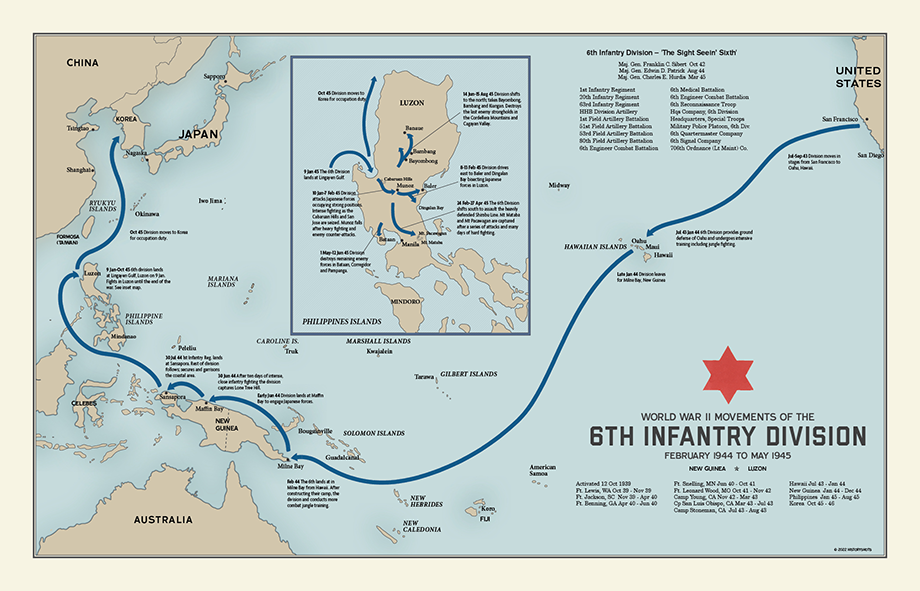
The 20th Infantry Regiment, transferred from the 2nd Division to the 6th Infantry Division in 1939, trained through the prewar maneuvers, was briefly motorized, and sailed from San Francisco in September 1943. After staging in Hawaii it landed at Milne Bay in February 1944 and reached the Toem-Arare area in June. On June 20 the regiment began the 6th Division's main attack toward Lone Tree Hill from the Tirfoam River. Terrain, poor unloading, Japanese fire from the defile between Lone Tree and Mount Saksin, and cave-and-ravine defenses slowed the advance. The regiment reached the crest on June 22 and then endured fierce counterattacks until the hill fight was reduced with help from the rest of the division.
The 20th served as ALAMO Force reserve during the Sansapor assault and moved there in late August, after the beachhead was already secure. Its larger combat test came on Luzon. Landing at Lingayen Gulf on January 9, 1945, it made early contact with the 37th Division near Dagupan and Calasiao, then shifted against the Cabaruan Hills. In February it fought several days for Munoz, finally taking the town on February 7 and helping destroy Japanese columns trying to escape through the area.
Northeast of Manila the regiment became a central element in the assault on the Shimbu Line. It attacked toward Mount Mataba and the Ampid River, made the division's most useful early gains south and southwest of Mataba, then continued the pressure while the 1st and 63rd Infantry worked on adjoining ridges. After a period on provost duty in Manila, the regiment returned north. In June it secured Highway 5 south of Bayombong, reached Pingkian and Bolog, and then pushed from Kiangan toward Kiangkiang and the Asin River. Rain, mountains, and Japanese rearguards slowed every mile; Company D's Corporal Melvin Mayfield received the Medal of Honor for action near Kiangan on July 29.
Sources and notes can be found on the Sources page.
View sources →