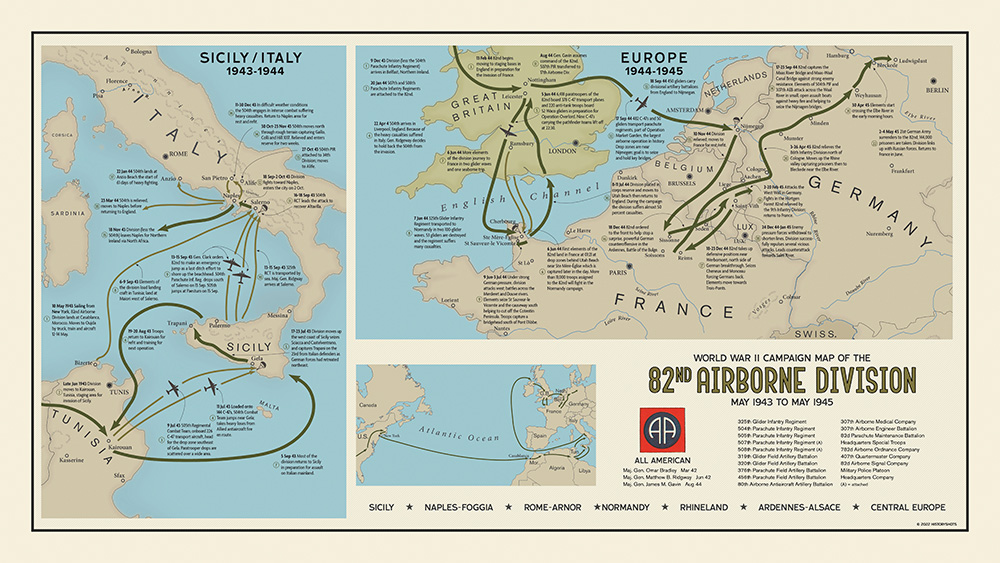
The 508th Parachute Infantry Regiment was activated at Camp Blanding, Florida, on October 20, 1942, and trained under Airborne Command at Fort Benning and Camp Mackall before sailing from New York on December 29, 1943. It reached Northern Ireland on January 8, 1944, and was attached to the 82nd Airborne Division six days later. Unlike the 504th and 505th, the 508th did not fight in Sicily or Italy. Its combat record began in Normandy, where it parachuted with the division on June 6, 1944.
The regiment landed west of the Merderet in the difficult Douve-Merderet sector. Scattered drops and German resistance complicated its original mission, but the regiment remained central to the 82nd's westward fight. On June 12, a reinforced 508th force crossed the Douve at Beuzeville-la-Bastille and reached Baupte the next morning. On June 16, after relief in the Baupte sector, the regiment joined the 325th Glider and 505th Parachute Infantry near St. Sauveur-le-Vicomte, helping establish a bridgehead beyond the Douve as German forces withdrew.
In Operation MARKET, the 508th dropped north of Groesbeek under Colonel Roy E. Lindquist. It guarded the Nijmegen-Groesbeek high ground, blocked movement from Nijmegen, assisted canal-bridge missions, and fought for key points along the Kleve-Nijmegen highway. Company A's fight for Devil's Hill and the regiment's hold on Wyler, Beek, and the ridge line helped secure the division perimeter while the Waal bridges were contested. During the Ardennes, the regiment held bluffs and ridges facing Vielsalm and Salmchateau, then fought covering actions during the withdrawal from the Salm line. In January 1945 it fought through the Deidenberg-Eibertingen and Holzheim area; at Holzheim, First Sergeant Leonard A. Funk, Jr., earned the Medal of Honor. The regiment ended the war attached to the 82nd Airborne Division, with campaign credit for Normandy, Rhineland, Ardennes-Alsace, and Central Europe.
Sources and notes can be found on the Sources page.
View sources →